
 Journal Search Engine

ISSN : 1226-4822(Print)
The Sociolinguistic Journal of Korea Vol.34 No.2 pp.331-378
DOI : http://dx.doi.org/10.14353/sjk.2026.34.2.11
DOI : http://dx.doi.org/10.14353/sjk.2026.34.2.11
The Recontextualization Trajectory of Social Actors in South Korea’s AIDT Policy: A Critical Discourse Analysis of AIDT Policy Documents
Abstract
This study examines how social actors are discursively recontextualized across South Korea’s AI Digital Textbook (AIDT) policy, an educational initiative that has sparked public debate. Drawing on van Leeuwen’s concept of recontextualization, this study analyzes six policy documents released between 2020 and 2024, tracing the trajectory of redefining stakeholders’ roles throughout three phases of policy development: the Incubating, Introducing, and Developing AIDT. The analysis reveals that each phase repositions four actors—the government, teachers, EdTech companies, and students—to legitimize the policy agenda. The government shifts from designer to central authority to supporter, while maintaining structural dominance throughout. Teachers are progressively recast from aides to policy actors to autonomous classroom innovators, a discursive move that transfers institutional responsibility onto individual professionals. EdTech companies are elevated from peripheral service providers to innovators embedded within public education infrastructure. Students, despite being invoked as the policy’s primary beneficiaries, remain passive objects across all phases. Central to this recontextualization is an “education ecosystem” discourse, which absorbs tensions between public and private interests and between top-down governance and teacher agency through the language of mutual benefit and professional empowerment. This study argues that this ecosystem discourse functions as ideological naturalization to legitimize EdTech companies as actors in public education.
초록
Vol. 40 No. 4 (2022.12)
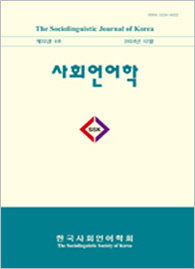
Frequency Published four times annually in March, June, September, and December
Doi Prefix 10.14353/sjk.
Year of Launching 1993
Publisher The Sociolinguistic Society of Korea


Online Submission
socioling.jams.or.kr
The Sociolinguistic
Society of Korea
socioling.com
Editorial Office Contact Information
- Tel: +81-10-3894-3164
- E-mail: schang@hoseo.edu