
 Journal Search Engine

ISSN : 1226-4822(Print)
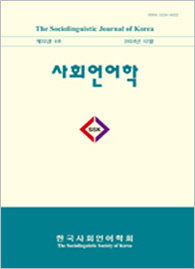
The Sociolinguistic Journal of Korea Vol.34 No.2 pp.181-197
DOI : http://dx.doi.org/10.14353/sjk.2026.34.2.06
DOI : http://dx.doi.org/10.14353/sjk.2026.34.2.06
A study on the usage pattern of connective endings in older adults with dementia
Abstract
This study established the usage pattern of connective endings in older adults with dementia observed by collecting natural spoken Korean from five participants living in the capital area. First, older adults with dementia are not fluent enough to speak consistently in daily conversations for more than one minute. Second, they generally use approximately 30 connective endings to communicate regardless of the duration of their illness, level of education, or KMMS-E(Korean version Mini-Mental State Examination) score. Third, there are six types of morphological high-frequency connective endings used by older adults with dementia: -a(-아), -ge(-게), -go(-고), -aseo(-아서), -myeon(-면), and -neunde(- 는데). These connective endings account for more than 70% of all communications. Fourth, the same classification applies to high-frequency semantic connective endings used by older adults with dementia, which control eight semantic functions. Fifth, the six types of connective endings are centered on speaking of a single event or narrating the events of an antecedent clause and the following clause in order.
초록
Vol. 40 No. 4 (2022.12)
Frequency Published four times annually in March, June, September, and December
Doi Prefix 10.14353/sjk.
Year of Launching 1993
Publisher The Sociolinguistic Society of Korea


Online Submission
socioling.jams.or.kr
The Sociolinguistic
Society of Korea
socioling.com
Editorial Office Contact Information
- Tel: +81-10-3894-3164
- E-mail: schang@hoseo.edu