
 Journal Search Engine

ISSN : 1226-4822(Print)
The Sociolinguistic Journal of Korea Vol.34 No.1 pp.395-417
DOI : http://dx.doi.org/10.14353/sjk.2026.34.1.13
DOI : http://dx.doi.org/10.14353/sjk.2026.34.1.13
Standardization of public terminology in the anti-doping
Abstract
This study aims to establish a linguistic foundation that enhances understanding among athletes, coaches, and the general public by identifying difficult-to-understand public terminology in the anti-doping field and revising it into more accessible expressions. A total of 154 terms used by the Korea Anti-Doping Agency were selected, and 93 terms were refined by applying certain criteria, including grammaticality, clarity, conciseness, familiarity, consistency, and unity. Fifty refined terms were finalized through expert consultation and an acceptability survey with 100 participants. The results showed that difficult Sino-Korean words accounted for the largest proportion of terms requiring refinement (44%), followed by polysemous terms (24%), and unfamiliar loanwords (20%). Clarity (51.4%) and familiarity (31.4%) were primary considerations in the refinement process. After refinement, the lexical composition shifted from Sino-Korean (60%), hybrid (24%), and loanwords (16%) to Sino-Korean (77.8%), hybrid (18.5%), and native Korean (3.7%), with no loanword-based terms remaining. This study contributes to preventing the disadvantages of athletes caused by terminological misunderstandings and provides a foundation for accessible anti-doping communication.
초록
Vol. 40 No. 4 (2022.12)
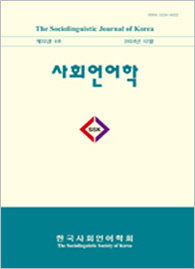
Frequency Published four times annually in March, June, September, and December
Doi Prefix 10.14353/sjk.
Year of Launching 1993
Publisher The Sociolinguistic Society of Korea


Online Submission
socioling.jams.or.kr
The Sociolinguistic
Society of Korea
socioling.com
Editorial Office Contact Information
- Tel: +81-10-3894-3164
- E-mail: schang@hoseo.edu